Adding Python to Your TypeScript Stack
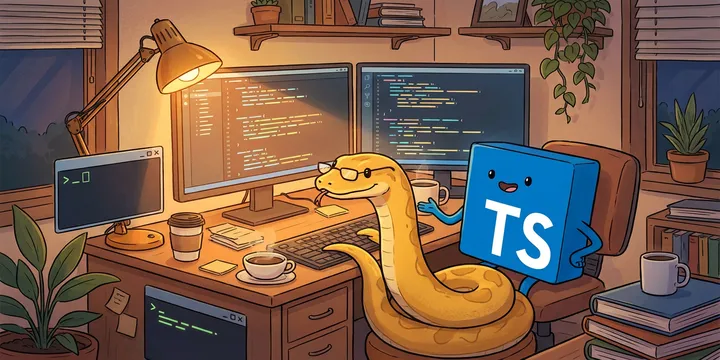
If you’re a TypeScript developer, you probably have opinions about Python. Maybe you tried it years ago and bounced off the lack of types. Maybe you’ve seen Python codebases that felt like a mess of untyped spaghetti. Maybe you’ve just been comfortable in the TypeScript ecosystem and never saw a reason to leave.
I get it. I was there too.
But something has changed. Python in 2025 feels surprisingly familiar to TypeScript developers. In some ways, it’s actually ahead. The tooling has converged. The type system is real now. And the ecosystem has coalesced around single, obvious choices in a way that JavaScript never has.
The AI Reality
LLMs are trained heavily on Python and TypeScript code. This means AI coding assistants are genuinely better at both languages—the suggestions are more natural, the error explanations clearer. If you’re pair-programming with Copilot or Claude, you’re working “on-distribution.”
TypeScript and Python are the two languages where AI-assisted development actually works well. That’s not a small thing as AI becomes part of the workflow.
There’s also the practical angle: every major ML framework speaks Python. PyTorch, TensorFlow, Hugging Face, LangChain—all Python-first. When you need to integrate with an ML model, you’re either writing Python or writing awkward wrappers around it.
FastAPI Feels Like Home
If you’ve built APIs with Express + Zod, or tRPC, or Hono, FastAPI will feel immediately familiar.
Pydantic models are basically Zod schemas. You define a class with type annotations, and you get automatic validation, serialization, and TypeScript-style inference. Unlike Zod, it’s built into the language rather than bolted on. The experience is remarkably similar.
class CreateUserRequest(BaseModel):
    email: EmailStr
    name: str
    age: int = Field(ge=0, le=150)
That’s your runtime validation and your static types in one declaration. Sound familiar?
FastAPI itself is built around async/await (yes, Python has that now), automatic OpenAPI generation, and type-driven development. The interactive docs are generated from your code. Change a type annotation and the API docs update automatically.
The mental model translates directly: define your types, let the framework enforce them, get documentation for free. If you’re coming from the TypeScript ecosystem, you already know how to think about this.
No More Dependency Anxiety
You know that feeling when you npm install on a six-month-old project? The prayer that nothing breaks? The cascade of deprecation warnings? The transitive dependency that suddenly requires Node 20?
Python largely avoids that problem.
The scientific community that shaped Python’s ecosystem cares deeply about reproducibility. When a researcher publishes a paper, the code needs to work years later. This cultural pressure means Python libraries tend toward stability over churn.
A uv.lock from a year ago tends to just work. Libraries that haven’t been updated in months are often stable, not abandoned. The micro-package phenomenon that gave us left-pad never took hold. Python packages tend to be more self-contained.
For production systems where you need things to keep working, this is liberating. You can actually step away from a project and come back without scheduling a “dependency update sprint.”
The Tooling Finally Makes Sense
Here’s where it gets interesting for TypeScript developers. Remember the JavaScript tooling wars? ESLint vs TSLint (RIP). Prettier vs StandardJS. npm vs Yarn vs pnpm vs Bun. Jest vs Vitest vs Mocha. The endless config files, the plugin compatibility nightmares.
Python went through that chaos too. But it came out the other side with clear winners:
uv is your new best friend. Think pnpm’s speed meets Cargo’s ergonomics. Written in Rust, it replaces pip, pip-tools, virtualenv, and pyenv in one tool. uv sync and you’re done. Proper lock files, reproducible environments, 10-100x faster than the old tooling.
Ruff is ESLint + Prettier in one. Also written in Rust, also stupidly fast. It replaces Black, Flake8, isort, and a dozen other tools. One config file. One command. No plugin compatibility issues because there’s nothing to plug in.
Pyright is… actually from Microsoft’s TypeScript team. The same people who built the TypeScript language server built Python’s best type checker. It powers VS Code’s Pylance extension, so your editor and CI see identical errors. If you like tsc --strict, you’ll feel at home with Pyright’s strict mode.
pytest is the one test runner. Not three competing options with different philosophies. Just pytest. Everyone uses it. Every library supports it. The plugin ecosystem is mature and stable.
The pattern here isn’t “Python caught up to TypeScript.” It’s that Python’s ecosystem has converged while JavaScript’s is still finding its footing.
Why Add Python to Your Stack
This isn’t about replacing TypeScript. TypeScript is still the right choice for frontend work and many backend services. This is about having both tools available.
When you can write Python comfortably, you unlock capabilities that TypeScript can’t easily provide: direct integration with ML pipelines, access to the scientific computing ecosystem, collaboration with data science teams who think in Python. You stop being the person who needs everything ported to Node before you can work with it.
The learning curve is gentler than you might expect. The type system concepts transfer directly. The tooling feels familiar. The mental model for async/await is identical. You’re not starting from scratch. You’re adding a dialect.
The Pitch
If you tried Python years ago and bounced off it, try again. The language hasn’t changed much, but everything around it has.
Modern Python with uv, Ruff, Pyright, and FastAPI is a genuinely pleasant development experience. Not “pleasant for Python”. Just pleasant. The ecosystem convergence means less time fighting tools and more time writing code.
You already know TypeScript. Python is the second language that makes the most sense to add. The tooling has caught up, the types are real, and the ecosystem is stable. Give it a weekend project and see if it clicks.